Harmonic-Wise Paper Reimplementation Pipeline
Overview
This guide explains the repository-owned harmonic-wise pipeline that was added
to reproduce the offline logic of
reference/RCIM_ML-compensation.pdf.
This topic is not the same as the repository’s direct-TE training families.
It belongs to the paper-faithful reproduction branch, which the backlog now
calls RCIM Model-Bank Reproduction.
The purpose of this branch is clear:
recreate the paper’s harmonic-wise modeling logic inside this repository;
obtain an offline comparison protocol that is genuinely paper-aligned;
prepare the bridge toward later online compensation work;
keep the result inspectable for colleagues, reviewers, and future deployment work.
At the current repository state, this guide covers the offline branch only.
The online compensation loop and the final Table 9 style benchmark are still
future work.
Guide Export Folders
This topic separates its guide-local material into:
assets/diagrams andNotebookLMsource packages.English/imported final EnglishNotebookLMexports for the concept and project tracks.Italiano/imported final ItalianNotebookLMexports for the concept and project tracks.
The imported export naming follows the repository rule that each filename must explicitly declare:
guide name;
track (
ConceptorProject);artifact type (
Guide,Presentation,Video Overview,Mind Map,Infographic).
Language is intentionally expressed by the parent folder name, so it is not repeated again inside each imported filename.
Why This Pipeline Exists
The repository had already trained several strong direct-TE models.
Those models predict the TE curve directly from angular position plus operating conditions.
That is useful, but it is not how the reference paper is structured.
The paper works in a different way:
represent each TE curve through selected harmonics;
predict the harmonic quantities from operating conditions;
reconstruct the TE curve from the predicted harmonic stack;
later apply that reconstructed TE information to compensation logic.
So this pipeline exists because the repository needed a branch that answers a different question:
can the paper’s harmonic-wise logic be reproduced here, with repository-owned code, artifacts, and reports?
Track Placement
The repository now keeps two comparison tracks:
RCIM Model-Bank Reproductionpaper-faithful harmonic-wise reproduction.TE Curve Verification Pipelinerepository direct-TE comparison under a common offline TE-curve evaluator.
This guide is only about RCIM Model-Bank Reproduction.
RCIM Model-Bank Reproduction Completion Rule
The canonical RCIM Model-Bank Reproduction completion rule is not a single campaign winner.
RCIM Model-Bank Reproduction is now closed as the faithful full-dataset model-bank
reproduction. Closure means the repository has run both forward and backward
paper-faithful grid-search campaigns, refreshed accepted archives, and
repopulated Tables 2, 3, 4, and 5 with inspectable per-target and
per-family status.
That means:
the primary
RCIM Model-Bank Reproductionreadout is the exact-paper table-replication report;the harmonic-wise TE-curve evaluator is still useful, but only as support evidence;
all-green benchmark coloring is not required for the faithful RCIM Model-Bank Reproduction closure; yellow and red cells remain evidence of the numerical gap under the recovered original protocol.
End-To-End Flow
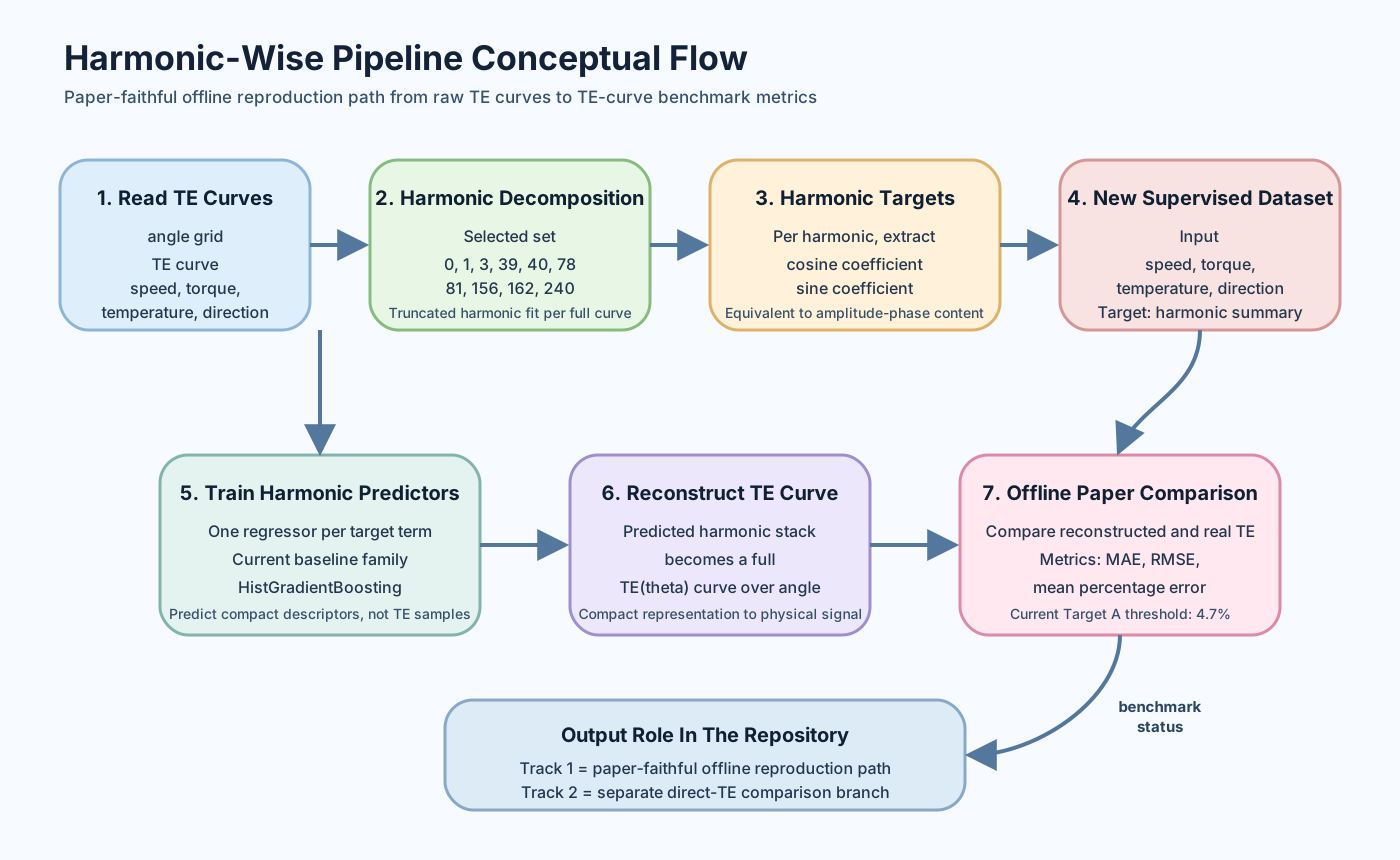
The pipeline starts from full TE curves, converts them into a harmonic summary, predicts those harmonic terms from operating conditions, and then reconstructs the TE curve for evaluation.
That means the model does not learn point-wise TE samples directly.
It learns a compact representation of the whole curve.
Stage 1. Read Curves And Operating Conditions
Each dataset item contains:
an angular grid;
a TE curve on that angular grid;
operating conditions such as
speed,torque,temperature, anddirection.
In the direct-TE branch, the angle itself is part of the model input.
In this harmonic-wise branch, angle is not the final learning input.
Instead, the full angle-resolved TE curve is treated as a signal to summarize.
Stage 2. Decompose The TE Curve Into Selected Harmonics
The pipeline uses a selected harmonic set aligned with the paper-oriented comparison scope:
01339407881156162240
These harmonics were chosen because they capture the practical periodic structure emphasized by the paper and by the repository’s own benchmark notes.
The decomposition stage fits a truncated harmonic representation of the TE curve.
Conceptually, the curve is written as:
TE(theta) ~= a0 + sum_k [c_k cos(k theta) + s_k sin(k theta)]
where:
a0is the offset term;c_kis the cosine coefficient for harmonick;s_kis the sine coefficient for harmonick.
Stage 3. Convert The Curve Into Harmonic Targets
For each selected harmonic, the current implementation stores the signal in coefficient form:
cosine coefficient;
sine coefficient.
This form is convenient for stable regression and reconstruction.
It is also directly connected to the paper quantities:
amplitude
A_k;phase
phi_k.
The relationship is:
A_k = sqrt(c_k^2 + s_k^2)phi_k = atan2(-s_k, c_k)in the chosen convention
So even though the repository currently predicts coefficient pairs, those
coefficients still represent the same harmonic content that can be expressed as
A_k and phi_k.
Stage 4. Build A New Supervised Dataset
This is the key conceptual shift.
The problem is no longer:
input =
angle + operating conditionstarget =
TE(angle)
The problem becomes:
input =
speed + torque + temperature + directiontarget = harmonic summary of the whole TE curve
So each supervised sample corresponds to one operating-condition point and one whole-curve harmonic representation.
That is why the pipeline is called harmonic-wise.
It predicts the ingredients of the curve, not the point-wise curve samples.
Stage 5. Train Predictors On Harmonic Targets
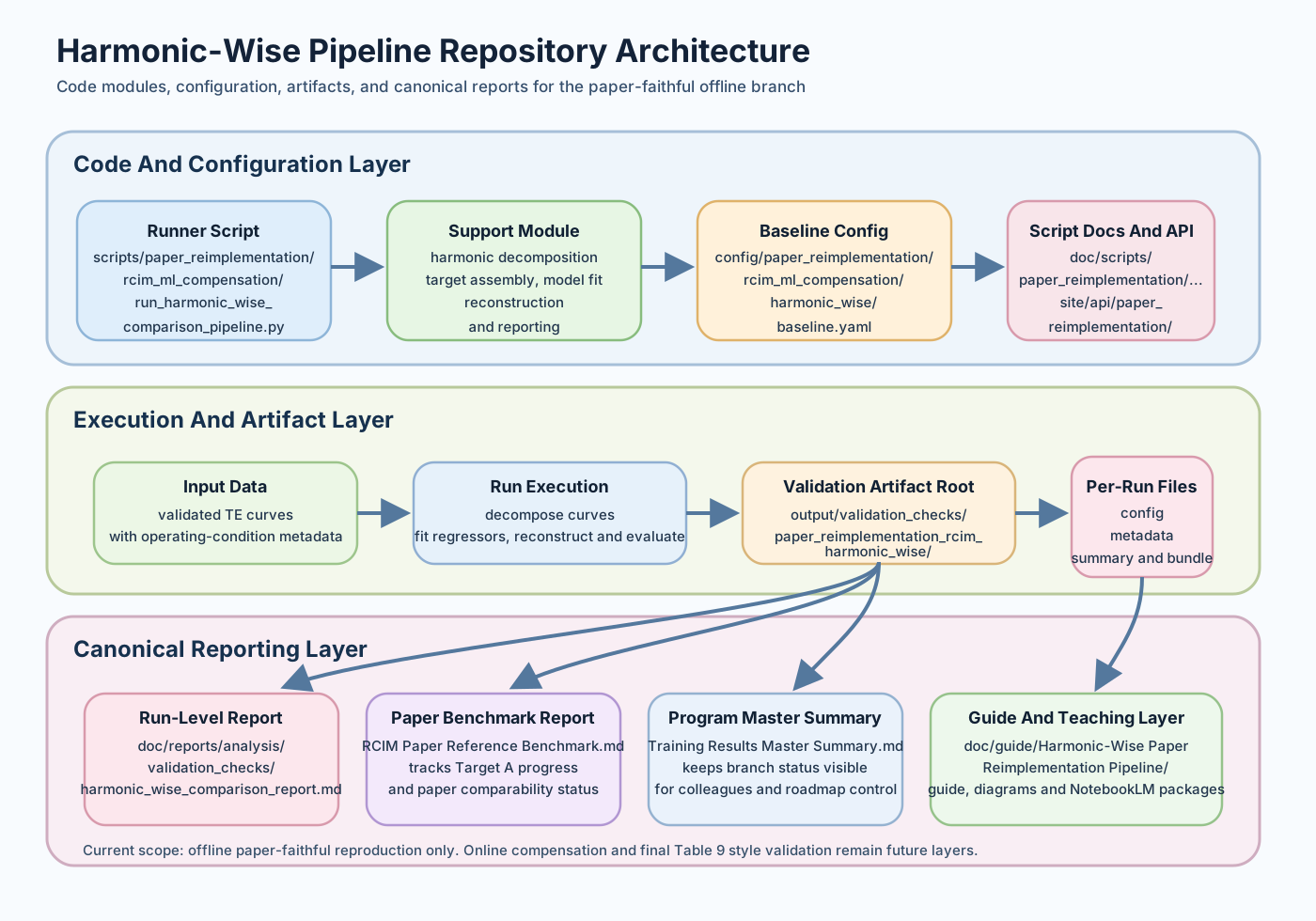
The current repository baseline uses:
one regressor per harmonic target term;
model family:
HistGradientBoosting.
That means the pipeline fits many small tabular regressors rather than one large end-to-end point-wise neural model.
This is already directionally aligned with the paper, where tree and boosting families dominate the deployable harmonic stack.
The baseline script is:
scripts/paper_reimplementation/rcim_ml_compensation/run_harmonic_wise_comparison_pipeline.py
The main support module is:
scripts/paper_reimplementation/rcim_ml_compensation/harmonic_wise_support.py
The current baseline configuration is:
config/paper_reimplementation/rcim_ml_compensation/harmonic_wise/baseline.yaml
Stage 6. Reconstruct The TE Curve
Once the model has predicted the harmonic coefficients for a new operating point, the pipeline rebuilds the full TE curve over angle.
This is the bridge between:
compact harmonic prediction;
physical TE behavior over the full angular cycle.
Without reconstruction, the pipeline would only output abstract coefficients.
With reconstruction, it becomes comparable to the paper’s offline TE-curve validation logic.
Stage 7. Evaluate The Reconstructed Curve
The reconstructed TE curve is compared against the real TE curve on held-out validation and test splits.
The main metrics are:
MAERMSEmean percentage error
The mean percentage error over the full TE curve is now a supporting paper-comparable metric for the offline phase.
The first repository-owned baseline established that protocol and produced:
validation mean percentage error:
9.474%test mean percentage error:
9.403%
The current offline paper target is:
<= 4.7%
So the comparison protocol now exists, but Target A is not closed yet.
RCIM Model-Bank Reproduction is closed separately from Target A: the model-bank reproduction
surface has been populated and archived, while the later TE-curve and online
compensation branches still need their own validation.
Why The First Baseline Still Matters
Even though the first baseline does not yet match the paper threshold, it already proved something important.
The truncation-only oracle with the same harmonic set reaches a much lower error than the learned predictor.
That means:
the selected harmonic set is expressive enough;
the bottleneck is the operating-condition predictor;
the next improvement work should focus on the predictor and target design, not on abandoning the harmonic representation itself.
Offline Playback Probes
The current pipeline also includes offline Robot and Cycloidal style
motion-profile playback probes.
These are not yet the final online compensation benchmark.
They are repository-owned preparation steps that:
exercise the predicted harmonic stack on profile-like conditions;
prepare the path toward later online evaluation;
keep the eventual
Table 9target visible from the beginning.
What This Pipeline Is Not
This pipeline is not:
the direct-TE training branch;
a finished online compensation system;
a TwinCAT deployment package;
the final
Table 9benchmark.
It is an intermediate but essential branch between completed Wave 1 and the
later online compensation path.
Current Repository Outputs
The current validation artifacts live under:
output/validation_checks/paper_reimplementation_rcim_harmonic_wise/forward/
The current human-readable validation report is generated under:
doc/reports/analysis/validation_checks/
The canonical comparison reports that summarize the branch are:
doc/reports/analysis/rcim_paper_reference/RCIM Paper Reference Benchmark.mddoc/reports/analysis/project_status/current/Training Results Master Summary.mddoc/reports/analysis/validation_checks/rcim_model_bank_reproduction/track1/exact_paper/forward/shared/2026-04-12-17-00-28_paper_reimplementation_rcim_exact_model_bank_rcim_exact_paper_model_bank_exact_paper_validation_tables_3_4_5_6_exact_paper_model_bank_report.md
Practical Reading Map
If you want to understand the branch quickly, read in this order:
this guide;
doc/reports/analysis/rcim_paper_reference/RCIM Paper Reference Benchmark.md;doc/reports/analysis/validation_checks/rcim_model_bank_reproduction/track1/harmonic_wise/...harmonic_wise_comparison_report.md;the pipeline script and support module.
Summary
The harmonic-wise paper-reimplementation pipeline changes the learning problem from:
point-wise TE prediction
to:
operating-condition-to-harmonic prediction
and then reconstructs the TE curve for evaluation.
That is exactly why it matters.
It gives the repository a paper-faithful offline benchmark path instead of only a direct-TE leaderboard.
The important operational nuance is that the harmonic-wise support branch and
the exact-paper table-replication branch must not be collapsed into one
winner-centric story. For RCIM Model-Bank Reproduction, the table-replication branch is primary.